

Helpful resources
What is the Emotion Wheel?
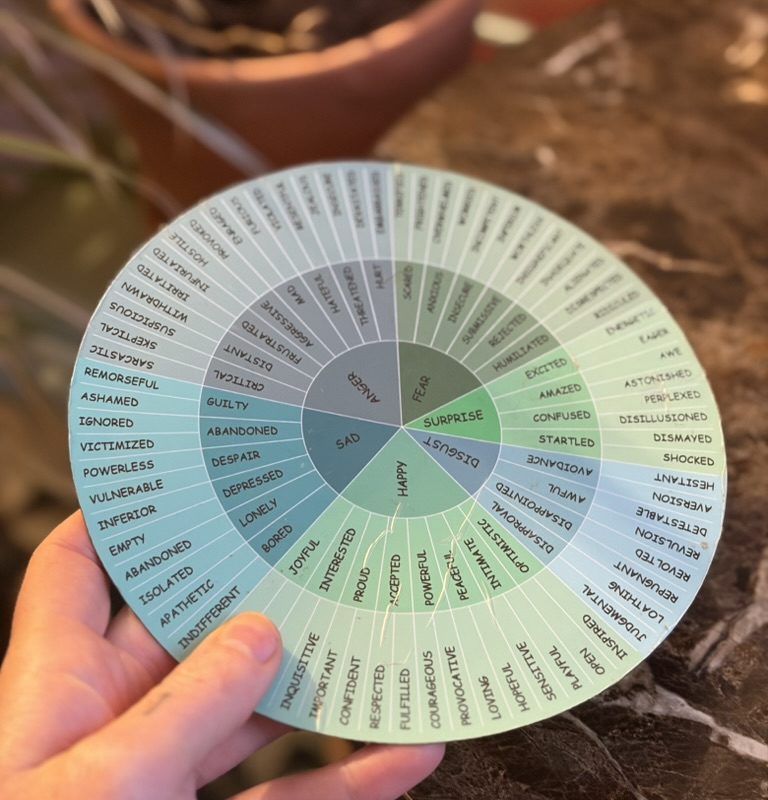
What Is the Emotion Wheel?
Originally developed by psychologist Robert Plutchik in 1980, the Emotion Wheel is a colourful wheel designed to help you map out your emotions.
At the very center sit core emotions—things like happy, sad, anger, fear, and surprise. But as you move outward toward the edges, those core feelings branch off into much more detailed and varied emotions.
For instance:
-
Anger might actually be hiding frustration, humiliation, or feeling overwhelmed.
-
Sadness might actually be grief, loneliness, or isolation.
-
Fear might really be inadequacy or uncertainty.
It acts like a prompt to get to the source of the emotion.
Why Naming Your Emotion Changes Everything
It might sound like a simple but giving a precise name to what you feel does something powerful in your brain.
1. It Down-Regulates Your Brain’s Alarm System
When you pinpoint an exact word for what you’re feeling, you engage the prefrontal cortex—the logical, grounding part of your brain. Simply naming an emotion calms down the amygdala (your fight-or-flight response) and reduces its intensity.
2. It Uncovers What You Actually Need
If you think you’re just “mad” at your partner, your instinct might be to shut down or start an argument. But if you look at the wheel and realise what you’re actually feeling is unappreciated or dismissed, the fix changes entirely. Now you have actionable insight.
3. It Can Help To Increase Emotional Regulation
Naming your feelings gives you back control. If you spot that you’re feeling ‘overwhelmed,’ you can pull out a grounding exercise; if you notice you’re feeling ‘angry,’ you can focus on working through the conflict
How We Use The Emotions Wheel in Our Sessions
I often like to utilise the emotions wheel in my sessions as it can serve as a practical tool whenever feelings become difficult to articulate. If you find yourself struggling to describe an experience, we can use the emotions wheel to connect to unpack the layers beneath a surface emotion.
It is also a gentle way to explore moments where emotions might be avoided. We might turn to the wheel as a reference point. I might ask you to look over the options and see if there is a word that feels closer to what you are experiencing.
This process isn’t about putting you on the spot or forcing your feelings into neat categories. It is simply a shared reference tool to help you gain clarity and navigate complex emotions.

Meet Emily
Emily McDonald is an Integrative Psychotherapist offering online and in-person therapy, and group grief walks in Walthamstow. Her approach is warm, collaborative and trauma-informed.
More about Emily